Homepage
Greece is a moderate power located in southeastern Europe. Though it is often compared to its ancient counterpart, a big part of modern Greece's identity has revolved around the fact that it has spent centuries under Ottoman rule. This is also true for the rest of the Balkan peninsula.
General Information
 Government
Greece is a unitary parliamentary republic, meaning its single and central government holds the ultimate power while its parliament is made up of representatives that direct laws. Its head of state is the parliament-elected president, though true executive lies with the prime minister.
 Nationalism
Greece's nationalism is mainly ethnic and religious nationalism. Most Greek nationalists are highly proud of their ancient roots, their independence from the Ottoman Empire and tie 'Greek' to Greek Orthodoxy. During the Byzantines, Greeks saw themselves as 'Romanoi' or Romans.
 Economy
Greece follows a capitalistic economic model with a free market regulated by the EU and a private flow of goods.
 Ideology
Greece is governed with the core tenets of liberalism in mind, that being freedom, democracy and equality. Modern Greece is also pan-European, the Greek state aligning itself with the EU.
 Reach
Reach
Ancient Greek culture, writing, language and institutions are all and have been highly studied topics for centuries. Modern Greece's cultural and political reach has been limited, and historically even more so due to longstanding Ottoman occupation.
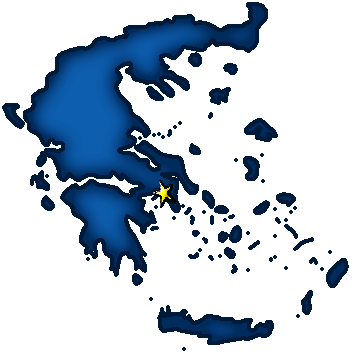
| Nickname: | The cradle of Western civilization |
| Population (2023): | ~10.41 million |
| Official Language: | Greek |
| Capital: | Athens |
| Currency: | Euro (€) |
| System of Government: | Parliamentary republic |
| National Symbols: | Dolphin, oyster plant, meander, olive tree |