
Society

History
Inevitable Centralization
Though, as time marches on, a single kingdom, Kingdom, manages to subdue the coast through informal personal unions. As the inland states stay relatively weak and semi-isolated, Kingdom is easily able to informally capture the inland and force it under its own sphere of influence. Through the span of a few centuries these inland states are formalized into provinces of Kingdom.Vassal
Vassal, on the far right of the coast, was one of the first republics to achieve cohesion. They belonged to the same culture group as the other more decentralized states but, due to their ideal geographic location, excelled at export of silk and tropical fibres unique to Vassal (then Republic). By the time Kingdom had subjugated the vast majority of what is now Country, Vassal was a weakened state suffering from a stagnating economy. Bordering the colonized New Land, they requested protection from Kingdom in exchange for semi-vassalage. Its sovereignty has slowly been eroding ever since.
Technology

Economy
Services (68.1%)
Industry (28.7%)
Primary (3.2%)

Geography
Natural Resources:
Environmental Hazards:
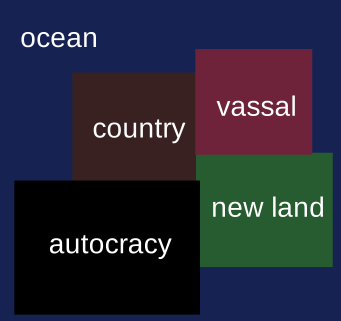
The map on the right does not depict relative sizes of the displayed countries
Departments, divisions
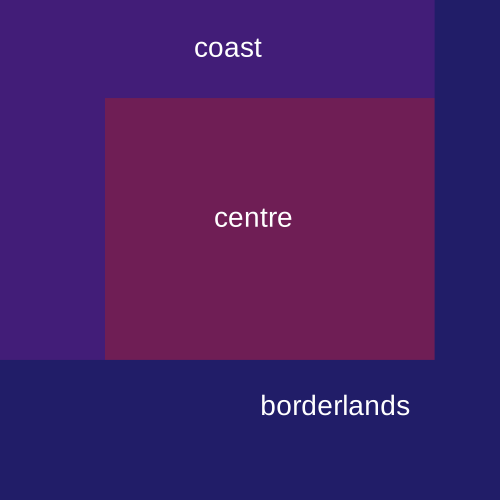
Country is divided into several (5) administrative divisons, those being the North, East, South, West and Centre. They are geographically divided into the coast, centre and borderlands.Geographic Map

Politics
Country is a constitutional democracy with a lower house of 1500 representatives that elect and send bills through to the upper house. Its upper house, in charge of actually approving bills, are made up of 75 senators delegated from Country's five administrative divisions. Every division gets 5 base seats (5x5=25) with the remaining 50 seats being allocated relative to that region's population.
Upper House
North: 15+5East: 15+5
West: 10+5
Centre: 7+5
South: 3+5
The upper house can enact an absolute veto which can amend changes to the constitution, change regional laws, education and general policy. This veto can be overwritten by a 2/3 majority from the lower house (1000 seats). They also confirm as well as manage international treaties and high government officials (heads of regulatory bodies).
Lower House
The lower house is made up of 1500 community-elected seats that primarily functions as a voting body. Each societal issue (defense, economy, vassal, etc.) has a committed committee populated by MPs. The amount of members in a committee they have is relative to the share of seats each party has. They are in charge of parliament agendas, hearings and amendments. Speakers of debates in parliament are decided through a digital lottery.
Legal System
Institutions
- The Popular Ministry is the organized national body responsible for investigating and prosecuting all kinds of crime, acting under mainly expediency. They are handled by the Ministry of Justice.
- The Council for the Judiciary is in charge of managing courts and legal quality aswell as protects career jurists from political pressure.
- The Council of State is both required to be consulted on draft legislation, not yet passed to parliament aswell as acts as the court of appeal for administrative law cases.
- Judges are career jurists.
Supreme Court
The single supreme court is located in the Capital and is the court of cassation. It is in charge of enforcement and equal application of the law and sets the precedent for civil law. They can also review and invalidate laws altogether under the condition that they are inconstitutional.Appellate Courts
There are four (north, east, south & west, centre) courts of appeal that combine various district courts. They are in charge of examining facts and law, with most appeals also ending here.District Courts
Each administrative division is split into 4 quadrants or districts are given various district courts (dependent on the population of the quadrant), with these courts being further divided into 4 sector chambers, those being administrative, civil, criminal and sub-district.